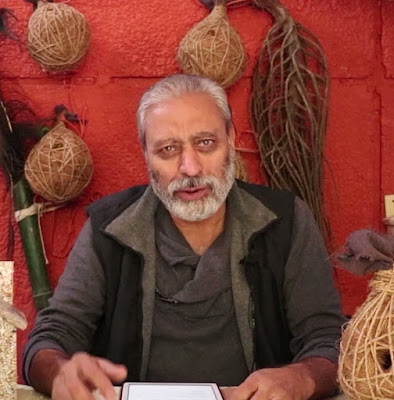
For 32 years, this organization has been a messiah for the needy, feeding thousands of people every day.


This is the story of the Veerji Da Dera organization, where every day, poor people are fed free food and the injured are treated.

The organization was founded in 1989 by the late Trilochan Singh. His sons, Brigadier Premjit Singh and Kamaljit Singh, are now carrying on his legacy. Kamaljit Singh runs a business, while Premjit is retired from the Indian Army.

Trilochan Singh was born in Myanmar and later settled in Delhi. He believed that service to the needy is the highest form of service. After his retirement, he dedicated his life to helping others.

Kamaljit Singh says that his father used to help the destitute and helpless people who would gather near the Shishganj Gurudwara in Delhi. He would clean their wounds and bandage them, and he would also give them free food. People began to call him "Veerji" out of respect for his service.

As Trilochan Singh's work grew, more and more people began to join him. Eventually, an organization was formed, and it is now known as Veerji Da Dera.

After Trilochan Singh's death in 2010, his sons took over the organization. Kamaljit Singh says that today, hundreds of people are involved in the organization, and they all contribute in different ways.

Every day, the organization distributes langar (free food) to the destitute and poor people of Delhi. The langar consists of dal, roti, and rice. The entire langar is prepared at one central location, and then workers deliver it to 25 different locations throughout the city.

The organization also provides medical care to the injured. Workers carry fever medicine, vitamin capsules, and ointments with them, so that they can provide immediate assistance when needed.

Kamaljit Singh says that the organization helps about 100 sick people every day. These people include homeless people, the destitute, and daily wage laborers who cannot afford the cost of treatment and medicine. These people come to the organization for help, and the workers do their best to provide it.

Today, more than 250 families are associated with Veerji Da Dera. They help in every way, from providing ration to providing service. The organization never asks for money from anyone; instead, people donate things like pulses, rice, flour, and medicine.

Kamaljit Singh says that this work is only possible because of the help of so many people. He is grateful for the selfless contributions of those who have helped the organization to grow and thrive. He says that he is never short of resources or helping hands.

11 Female Sanitation Workers in Kerala Win Rs 10 Crore Monsoon Lottery


In June, a group of 11 women who work as sanitation workers in the state of Kerala, India, decided to pool their money to buy a lottery ticket. To their immense joy, they discovered last week that they had won the jackpot of 100 million rupees ($1.2 million; £946,685).

These women are part of a team responsible for collecting non-biodegradable waste from households in Parappanangadi town, located in Kerala's Malappuram district. Typically, they earn around 250 rupees a day from monthly payments made by households and occasionally receive a share of the revenue generated by the local corporation from selling the segregated waste they collect.

Despite their hard work, the women admitted that the income they earned was not enough to meet their needs. Many of them had resorted to borrowing money and taking loans to support their children's education and other essential expenses. To improve their financial situation, they would occasionally join forces to purchase lottery tickets.

The lottery system is mostly illegal in many Indian states, but Kerala's government runs a legal and highly popular lottery program. Private lotteries, however, are banned in the state.

One member of the group, MP Radha, was usually responsible for buying the tickets. Last month, they decided to invest in a 250-rupee ticket for a monsoon bumper prize lottery, which is issued for special occasions like festivals.

Kuttimalu, aged 72, initially felt sad as she didn't have enough money to contribute. However, another member, Cherumannil Baby, offered to lend her half of the required amount, and the two women put in 12.5 rupees each, while the remaining nine women paid 25 rupees each.

To their surprise, the group won the jackpot, but they only learned about their victory a day after the draw when one of them asked her husband to check the results.

The lottery win has brought immense relief and hope to these hardworking women, each of whom has their own compelling story. For instance, Cherumannil Baby, aged 62, had lost her house during the devastating floods in Kerala in 2018. Now, she plans to use the money to rebuild her home and pay off debts.

K Bindu, aged 50, tragically lost her husband to kidney failure last year, and the family struggled to afford his transplant. She now hopes to use the winnings to educate her 15-year-old daughter for a better future.

Lakshmi, aged 49, had been anxious about her family's future due to her husband's struggles to find work as a construction worker, particularly during heavy rains in the state. With the lottery win, she can now focus on her daughter's education.

Leela, aged 56, was facing financial worries related to her daughter's surgery and had already borrowed money for her wedding by taking a loan against her house. The lottery prize will now help ease her burdens.

After deducting government taxes, the group will receive 63 million rupees. Cherumannil Baby and Kuttimalu will equally divide their share of 6.3 million rupees, while the others will each receive 6.3 million rupees.

Despite their newfound wealth, these remarkable women remain dedicated to their community work. Alongside collecting waste, they also contribute to constructing public toilets and installing waste disposal facilities, as coordinated by the Suchitwa Mission, an agency overseeing these efforts across the state.

Even after their life-changing win, the 11 women have committed to continue their sanitation work, acknowledging that it was their collective effort that brought them prosperity.

Shield your soul


 Let them curse you and say ill, Let them assassinate your name. 
All you are answerable to Is your own soul's pure flame.

A snake spits venom forth Because it is in its nature. 
What you say about others, Is what you are, my brother.

So let them talk, and let them rage. Let them try to bring you down. 
The truth will rise above their lies, And you will stand tall, crowned.

For, in the end, it is only What you do that matters. 
Your actions will speak louder Than any words they can shatter.

So hold your head up high, And let your light shine bright. 
The darkness cannot defeat you, For you are a child of light.

Karma is the destiny man weaves for himself

Noticing his shaven head, I asked, “Has something wrong gone in the family?” He said, “Yes, I lost my elder brother.”

Already pained over the loss of my own mother, I asked how.

He said his brother committed suicide. He was a little over 60 years. He had an argument with his wife the evening before and was disturbed. He went to his field and hung himself to the tree.

He was with his wife for four years, prior to which he served his jail term of 15 years.

This had me curious and I asked why jail, to which he said his brother had murdered someone in the past.

I asked if he was an aggressive person to which he said, “yes, he was quite aggressive but not anymore”

We change as we age. We don’t change because we are learned but because we are helpless. We are aging and we can’t continue to be what we had been while we were young and active. When we are physically weak, we are forced to be what is contrary to our original personality, we are forced to be levelheaded (at least look like that), act sensible and wise.

Any death is traumatizing and so was the death of the person who was murdered decades ago. The family suffered irreparable loss and unbearable was the agony that followed later. How could all this pain and experience go in vain! Now his family is going through the same pain and he is witnessing all that while being out of the body.

Brother (murderer) is no more. He killed himself. What is it if not the fruit of his own karma!

We can’t blame anyone for what we are getting. We are reaping what we sowed and will reap what we are sowing now. Nothing is just and fairer than the law of Karma.

Be good, do good. Forgive all.

Life is too short to be revengeful!

कर्मों से डरिए ईश्वर से नहीं, ईश्वर माफ कर देता है कर्म नहीं..


The Nest Man Of India Who Built 2.5 Lakh Homes For Birds

Mr. Rakesh Khatri has built over 2.5 lakh homes for birds and trained over 10 lakh students.

The resident of Delhi, spent his childhood in Old Delhi’s Chandni Chowk where sparrows could easily find enough space for themselves because of the old architectural designs.

 “While I was growing up, sparrows would make their nests on switchboards, window panes, balcony, and we were always asked by elders not to switch on ceiling fans because of fear of getting them hurt”, says Rakesh Khatri

After moving to Mayur Vihar, a developing part of Delhi, he discovered that his childhood winged friends were disappearing because the new architectural designs left no room for them.  Besides, people have also become intolerant towards the supposed ‘nuisance’ birds create.

In 2008, Seeing the declining number of sparrows, Rakesh Khatri decided to quit his profession of photography & Short filmmaking and started building nests for birds.

His attempt with coconut husk and crumpled newspaper brought no fruitful result,  he then started making these nests with bamboo sticks and placed them in various parts of his colony.

To everyone’s surprise, there were four sparrows in each nest he placed within a few days.

Thrilled and delighted, Rakesh continued the process of nest making and to date, he has built 2.5 lakhs nests all over the country. He has also trained more than 10 lakh students to create such nests.

 In order to promote his mission and raise awareness, he founded Eco Roots Foundation in 2012. He contributed his life to environmental preservation and then never looked back.

 “sparrows are my childhood friend, how can I leave them to die”, says Mr. Khatri.

He has been awarded several times for his ambitious environmental mission and dedication towards saving sparrows. He made into the Limca Books of records twice for the highest number of workshops conducted and the largest theatre events on climate change.

He’s also known as ‘The Sparrow Man’ and ‘The Nest Man of India’.

While these nests are home to birds, they also enhance the beauty of nature and surroundings. Do your bit to save these birds.


School on wheels bring the classroom to the students


In India's underprivileged and unserved communities, hope sometimes comes on a bus. The project that kicked off seven years ago to bring the classroom to the children with little access to education has seen an enrolment surge since the pandemic hit.


The project ‘Hope Bus’ is a brainchild of Marlo Philip, founder of an NGO Tejas Asia

Tejas Asia has four buses that go to two different locations per day. With that, it is able to cover 8 locations in a day.

Bus mobile school reaches out to communities in Delhi with no basic facilities and no access to education

Children are divided into three groups – Advanced, Intermediate and Beginners. This makes teaching easier. The children are taught English, Hindi, Maths, EVS and GK.

Children with some potential are enrolled in Government schools.

In most cases, both parents leave for work in the morning and the school on wheels tries to fill the gap.

“We, not just give them education, but also love and care they deserve. We even provide them free meals after the class”, says the class coordinator Ebna Edwin.


Children enjoy these classes and look forward to attending the same.

“When I am leaving, they ask me if I will come the next day too. If I am unable to come for some reason, they even phone me. The unconditional love of children keeps pulling me to them. I feel so loved and blessed”, says Anu Singh who has been teaching here for 5 months.

Mim Akhtar joined classes three months ago after she saw more children attending the same. Her younger sister too comes to the classes.


“I used to see the bus coming here daily. Everybody was studying so I too felt like coming and I love coming here.”

Mim doesn’t go to formal school and enjoys learning from the Hope bus.

“I study English, Hindi, and Maths here. They show us videos to help us learn better. I learn music too. Mam also sings very well,” says Mim excitedly.

Her mother Manowara Bibi is a rag picker who hopes that at least her daughter would have a better future.

As the pandemic struck in 2019, Tejas Asia was no exception to staying unstirred. Parents stopped sending children to school and they had to be convinced about the social distancing measures that were being followed. Social distancing meant the requirement of greater space but with extra staff and resources, things could be managed well.


Marlo wishes to have more buses, not just in Delhi but other states too.

“We want to expand the whole program, everything we do under the program Tejas Asia, be it education, food program, water systems, medical program, and whatever that can help these families and these children. Our dream is to see hope in every community and every life”, says the founder of Tejas Asia, Marlo Philip.


This report comes from Bengali Basti in Vasant Kunj, Delhi.

Delhi’s Shyam Rasoi serves full thali for Re 1, feeds over 1000 daily

Could you ever have imagined someone selling a complete thali for just Re 1? Well, you need to visit Nangloi’s Shyam Rasoi between 11 am and 1 pm. See it to believe it. 
You dont have to be poor to have this thali. It is for everyone and people from all walks of life come here for a meal. 

51-year-old Pravin Goyal, who runs the kitchen, says, “around 800-1000 people come here everyday for lunch. Whatever food is left, we serve it in the nearby blind school, leprosy home and old age home. In the morning, we serve tea and bread too at nominal cost.”


“Everyone feeds the hungry but here we want their souls to get contented. We serve them healthy and delicious food... one that they can not afford in routine life. We serve them 3-4 curries, dessert, chapati and rice in every meal. Today’s menu has palak paneer, pindi chhole, Punjabi kadi, mixed veg, biryani, paratha and gajar ka halwa. The menu changes everyday. Their happiness and blessings mean a lot to me and motivate me to do a lot more for them. ”


On being asked about how he manages all the expenses, Pravin said, “I am not paying anything from my pocket. I receive vegetables from farmers and others. People donate ration and money too. There is so much love and support coming from people.”

   
Pravin is assisted by some paid workers as well as volunteers. 
He took this initiative two years ago when he priced thali at Rs 10. However, after Covid outbreak, he reduced the price to Re 1 so that no one goes hungry.
The thali is priced at Re 1 but if someone can't pay, they are still served the full meal without discrimination.


Soni, 9, has been eating at Shyam Rasoi for four weeks. The smile on her face reflects how full and happy she is. 

“When I have money, I pay else I don't. Uncle doesn't ask me to pay. He even packs food for my family for free. They serve palak paneer, shahi paneer, aloo paratha, gobi paratha, pakode, etc. I am so glad that they are now serving carrot pudding too. Had this kitchen not been there, we could have died of hunger.”

The tea in my hand is sponsored by Shyam Rasoi

Chandigarh NGO sets up mobile library in minivan to help underprivileged students

In the wake of Covid19 pandemic, an NGO based in Chandigarh has set up a small library in a minivan to distribute books among the unprivileged students.

Sandeep Kumar, founder of the NGO -Open Eye Foundation -collected books from various sources to help the students who can not afford to buy books amid the financial crisis due to Covid19.

“After completing my studies, I got an idea to reuse the books for other students. In December 2016, I started this initiative and organised camps in various schools. People appreciated and came forward to help me with the study materials", said Kumar.

Since then, Kumar has been travelling in his mini van, filled with books and writing materials collected from various houses to make them available to students from slums and colonies.

“Distribution via scooter during lockdown period wasn't feasible so I got a minivan. I give aways masks and sanitary napkins too along with study material,” Kumar further added.Kumar has collected over 40,000 books in the last three years and distributed around 10,000.

Motto of his foundation is ‘Education from Trash’.


'Doctors For You' faces financial crunch

'Doctors for You' - a Trust run by some Delhi-based doctors - has been actively looking after COVID patients since the outbreak of the pandemic in Delhi. The Trust's first 100-bedded COVID care centre at Shehnai Banquet Hall shut down recently as the number of cases stagnated while the recovery rate improved.
Their 500-bedded COVID care centre at CWG Stadium, taking care of patients with mild to moderate symptoms, remains operational till date.

The CWG centre had over 340 beds occupied recently. They discharged patients who had already spent 10 days at the centre so that they could free up some beds.

The source of funds for the Trust is a private company called HCL. But with a sudden jump in COVID cases of late, 'Doctors for You' finds it difficult to run the centre.

“We have the capacity to increase 100 beds at CWG Stadium centre but we lack manpower. We have to pay salaries of the existing workforce. We charge not even a single penny from patients. We provide them free kits which include buckets, slippers, soaps, toiletries, etc. We dont know how long we can run the centre with this financial crunch," says Dr Ravi Kant from 'Doctors for You.'


Indian women demand division of household chores

From restrictions on their movement to being forced to do myriad household chores, women are facing the impact of the lockdown.

Subarna Ghosh, who runs a charity working on reproductive justice, has filed an online petition urging Prime Minister Narender Modi to step in and ask men to divide household chores.

“I filed it because inequity was already there, but the kind of imbalance in housework following the lockdown has come absolutely in our faces”, says Subarna.

Subarna lives in a small apartment in Mumbai with her husband and two children. In the beginning, when the lockdown was announced, she was fine but with several lockdown extensions, she was annoyed as nobody in the family was helping with household chores.

This resulted in more arguments; she scolded her children more as she alone carried the whole house workload.

Then came a time when she totally gave up and stopped doing any household chore. As things piled up, family members realised what Subarna was going through and decided to help in whatever possible way they could.

Lockdown forced people to sit together under the same roof for a long time. In some cases, it was a cause of friction while in others people got time to discuss affairs around them and understand each other better.

As per a report by International Labour Organization, women in urban India in 2018 spent 312 minutes a day on unpaid care work while men spent 29 minutes. In villages, it was 291 minutes for women compared to 32 minutes for men.

So far, over 70,000 people have signed Subarna's petition.

Aditi Prasad, a physiotherapist, lives with her husband and two children in Delhi. Her situation was no different.

“It was like a nightmare. All of a sudden we heard the news that no maids would be allowed to work. There is so much to do from washing clothes to ironing clothes, cooking food to feeding kids, dishwashing, etc, all was on my head. It was a big problem for me” says Aditi.

Aditi also complains about prevalent patriarchy in our society.

“It is male-biased society. Men don't usually work and they are not even expected to work,” says Aditi.
After almost 10 days, Aditi’s husband Gaurav realised how traumatic it had become for his wife to manage the whole house.

“I have just started working from home and I know how painful it gets. Maybe I am helping her with 25-30% of the work but again even that is not too much assistance that I am extending," says Gaurav

On being asked if Subarna got any response from PM Modi, she said, “I haven’t got any direct responses as yet but I am quite sure that they would be following up on it."